The wording has now been updated in both the Spanish and English version of the Pilgrim Office website, so though there are still questions around what the wording means, at least it is consistent and probably here to stay.
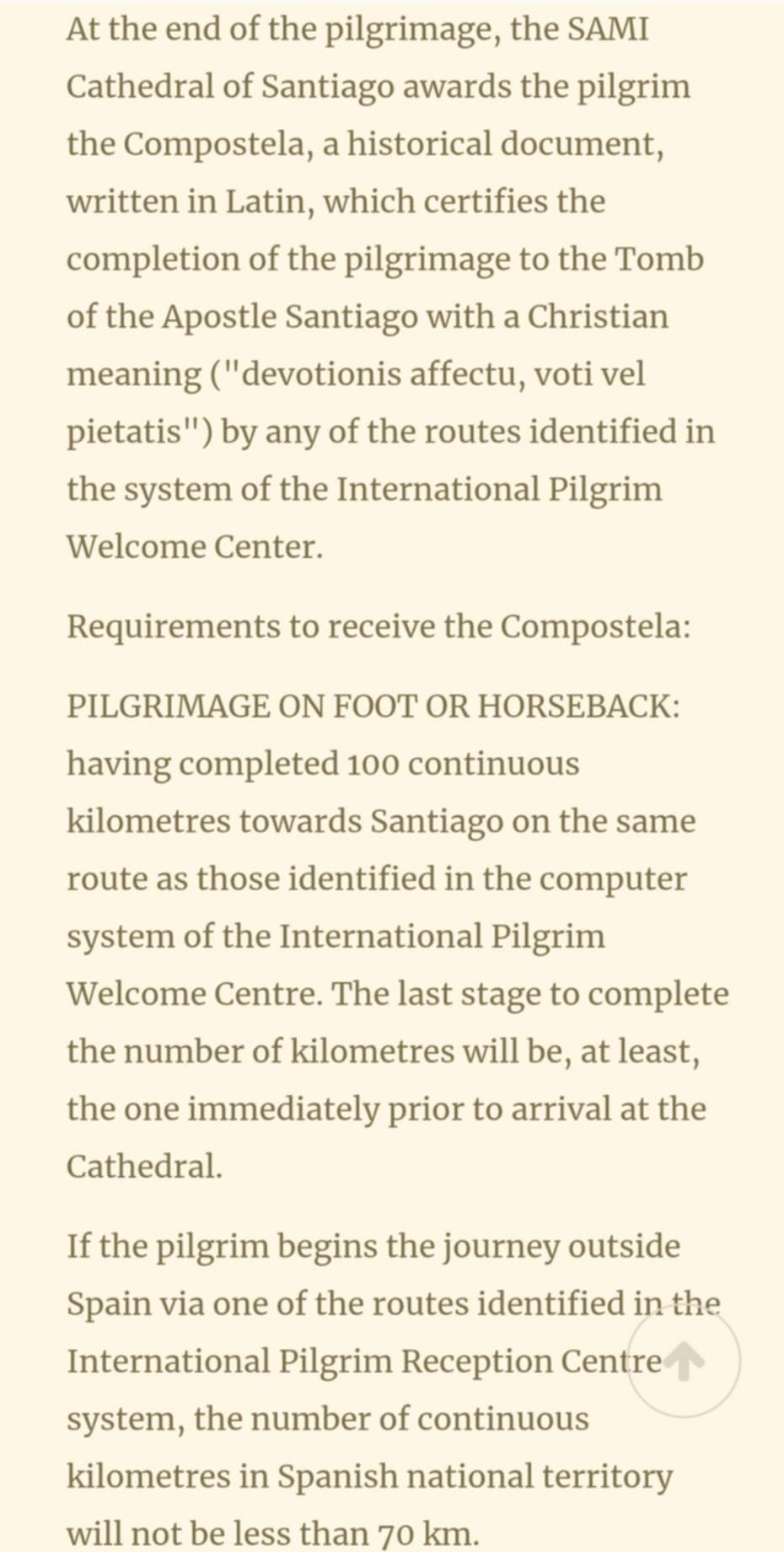
Screenshots from today, 12 Feb 2025: Left, Spanish website, google translated; and right, English. Both state the rule is to complete a minimum of 100 ‘continuous’ kilometres.

In January, we were told that the rules would indeed be changed and Ivar (below) went to the Pilgrim Office to get a semi-official clarification. It’s now 9th of February and the Pilgrim Office website has updated the text of the requirements for obtaining the compostela. But …
On the SPANISH website, this link, it says:
(edit: said, yesterday, 9. feb! Changed today, see new text below): Pilgrimage on foot or on horseback : having walked 100 km along any of the routes recognised as official by the SAMI Santiago Cathedral.
Requirements to receive the Compostela: (my highlight in bold)
PILGRIMAGE ON FOOT OR HORSEBACK: having completed 100 continuous kilometres towards Santiago on the same route as those identified in the computer system of the International Pilgrim Welcome Centre. The last stage to complete the number of kilometres will be, at least, the one immediately prior to arrival at the Cathedral.
However, on the ENGLISH version of the website, this link, it says (my highlight in bold):
- Make the pilgrimage for religious or spiritual reasons, or at least an attitude of search.
- Do the last 100 km on foot or horseback, or the last 200 km by bicycle. It is understood that the pilgrimage starts at one point and from there you come to visit the Tomb of St. James.
So – if you try to access the information in English, it still says ‘last 100’, but if you use the Spanish website and google translates it for you, it doesn’t. Also, in the Spanish text it said 100 km continuos – continuous – but not anymore, so there are still changes being made.
There is a lot of discussion about this – still – as people interpret the text and potential change in the rules differently. Speculation is rife online at the moment, so I am reserving any judgement until there is a comprehensive announcement to end this debate once and for all.
Please check the official Spanish Pilgrim Office website – https://oficinadelperegrino.com – before making any changes to your camino plans!
***
From January: Ivar – who runs one of the biggest camino forums as well as Casa Ivar, luggage storage and online pilgrim shop – went down to the pilgrim office and asked the questions we have all been wanting to ask.
In short: There is still a minimum 100 km requirement, but pilgrims no longer need to walk the last 100 km from familiar places like Sarria, Vigo, Ferrol etc, just the last stage/day from say O Pedrouzo or Padrón into the cathedral, and a 100 km in total.
For cyclists, the requirement is still 200 km, unless the bike is electric, in which case you won’t be eligible for your compostela! They’ll hardly check your bike, but they may ask.
I checked the official Pilgrim Office website, where it (now) says:
Requirements to receive the Compostela:
- Pilgrimage on foot or on horseback : having walked 100 km along any of the routes recognised as official by the SAMI Santiago Cathedral.
No mention of ‘consecutive’ or the ‘last’ 100 km of any recognised route, which is what has been the general understanding up until now. This is what has made Sarria so crowded and the trail from there so busy.
Removing the ‘consecutive’ requirement would allow ill and injured pilgrims to skip the hardest parts and complete a gentler journey, which I assume is the idea – as well as relieving the pressure on Sarria and other last-100-km places.
But it would also open the door to a ‘pick-and-mix’ camino where pilgrims could cherry-pick the perceived best bits, like walking over the Pyrenees to enjoy the view, then popping over to León to see the cathedral and walk a stage or two, nip into Rabanal and hike up to the Iron Cross at sunrise, and then start in easily accessible Arzúa or O Pedrouzo for the last ‘stage’ into cathedral square. But (my highlighting in bold):
- The Camino can be done in stages, as long as they are ordered chronologically and geographically. However, if only the minimum distance required (100 or 200 km) is done, the stamp must always be placed at the beginning and end of each stage, including the corresponding date, so that it can be seen that the pilgrim has resumed the Camino in the same place where he had left off (that is, it must always be stamped in the place where it began, even if we had already stamped in the same place at the end of the previous stage).
- The goal of the Camino is the Tomb of the Apostle in the city of Santiago de Compostela, so the pilgrimage is made in this sense. When you set out on the pilgrimage, you choose an official route and you follow the same chosen route, without alternating or mixing pilgrimage routes.
So you can’t suddenly jump over to a different route – unless it is one that branches off from the one you started on, I assume – unless of course you do it for more than 100 km. And it has to be done in geographical and chronological order, ie getting closer and closer to Santiago.
Please note that the two-stamp rule is still in force though! You will need two stamps a day for the last 100 km of your camino, consecutive or not.
It will be interesting to see how this impacts pilgrim crowds and behaviour, if many will take advantage of the option to cherry-pick or if most will still prefer to walk longer consecutive stages.
I must admit that for me, seeing the landscapes change gradually as I move towards Santiago in one continuous and unbroken walk, is what makes it special. Seeing the same people, making connections along the way, getting into a routine of walk-eat-sleep-repeat feels calming and joyful. And of course no one is saying I have to stop doing that, so these changes won’t really affect me.
What are your thoughts?
 Somewhere Slowly
Just seen Ivars’ video too. It provides for a new or maybe just a varied breed of existing traveler.
A pick and mix or time poor or adventure hiker as well as those possibly injured after a longer hike and want their Compostela.
I didn’t see the ruling on E bikes coming out this way. But it makes sense on the effort versus reward / spirit of the Camino front.
Best Regards –
Always enjoy your Blog
Ian x